Projects / Ontology of funerary artefacts at the Egyptian Museum in Cairo
Ontology of funerary artefacts at the Egyptian Museum in Cairo
How do you make a machine not only store information about museum objects, but also reason about them?
- Period
- Nov. – Dec. 2025
- Context
- Semantic web, Sorbonne Université
- Team
- Ezéchiel Sawadogo, Mamadou Diouhé Barry, Faycal Salhi, Alexiane Arphexad, Victoria Eyharabide
- Tools
- Protégé, Pellet, owlready2
The idea
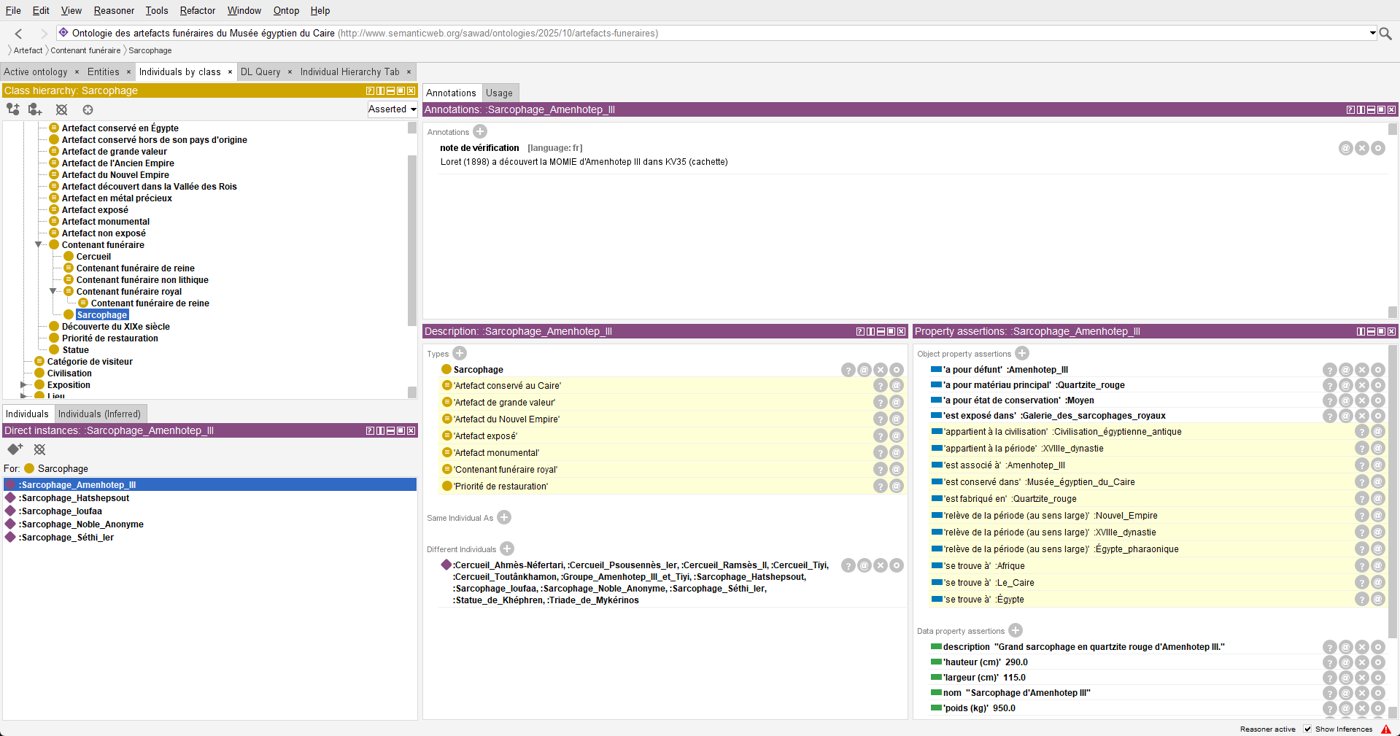
An OWL 2 ontology of the royal sarcophagi and coffins of the Egyptian Museum in Cairo: the deceased, archaeologists, tombs, dynasties, materials, museums and exhibitions. It does more than describe: from the deceased alone, the reasoner infers a coffin's dynasty, historical period, royal status and current location (city, country, continent).
60classes
61properties
121individuals
6SWRL rules
What was implemented
- Property chains, restrictions, defined classes and disjointness axioms.
- SWRL rules: automatic dating of objects, detection of pieces kept outside their country of origin (the sarcophagus of Seti I is in London), restoration priorities, visitor fees.
- Modelling exceptions in a formalism that does not allow them: Hatshepsut, both queen and pharaoh; stone sarcophagus versus gold coffin; the open-world assumption.
- Consistency checking: a data-entry error (a “wooden sarcophagus”) is detected and explained by the reasoner.
- Reasoning with Pellet, 11 SPARQL queries, and a Python script (owlready2) that reproduces every inference.
OWL 2 · SWRL · SPARQL · Protégé · Pellet · Python · owlready2