Recognising characters in Byzantine seal monograms
A semi-automatic pipeline that locates and then identifies the intertwined Greek letters in monograms, to build an annotated image base that researchers can use.
- Period
- Jan. – June 2026
- Context
- Master's thesis (year 1) · ANR BHAI project
- Supervisor
- Victoria Eyharabide
- Authors
- Mamadou Diouhé Barry, Ezéchiel Sawadogo
- Result
- 18/20, top of the class
The problem
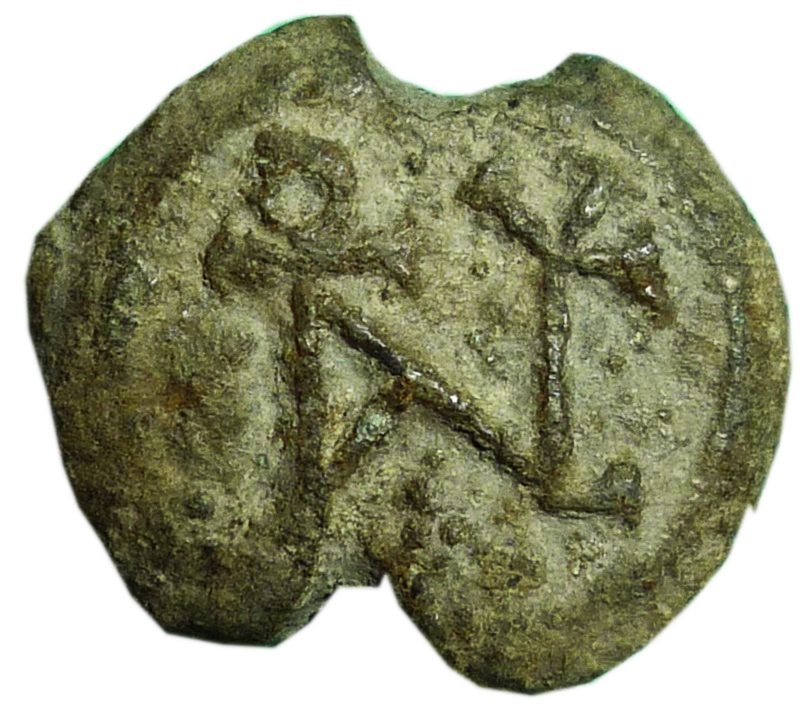
Byzantine lead seals are a major source for the history of the Empire: they identify their owners through inscriptions, images and monograms. A monogram superimposes several letters into a single design, and the same arrangement of strokes may allow several readings. Deciphering them takes an expert, yet there are tens of thousands of seals.
The approach
Separate the two difficulties: first locate each character within the tangle, then identify it. We annotated the corpus (polygon boxes), trained the models with cross-validation and analysed the confusions class by class.
Results
- Detection: YOLOv8s, 100 epochs, 640 px images — 351 images, 49 classes, 5-fold cross-validation.
- Classification: fine-tuned ResNet18, compared with a simple CNN and ViT-Tiny — 2,143 crops, 26 classes.
Try the model
Both models are available online: drop in a drawing of a monogram and the detector boxes and names each letter; drop in a single character and ResNet18 identifies it. (The interface is in French.)
Follow-up: the DH2026 paper
The same corpus led to a paper presented at Digital Humanities 2026 (Daejeon, South Korea): classifying the state of preservation of 625 seals into four levels (M0–M3) by comparing pre-trained encoders, with DINOv2-Small giving the best baseline. See Publications.
PyTorch · Ultralytics YOLOv8 · torchvision · scikit-learn · Supervisely · Label Studio · Google Colab (T4 GPU)